Discovery Expedition Disaster
Chasing SunlightDiscovery Expedition Disaster is the failed eastern expedition that left the Discovery stranded in the Grave of Wood, with its crew vanished and its lifting gas largely escaped. Years later, the Endeavor finds the derelict beside a defaced bier, turning the disaster into both a material recovery mission and a stark measure of how far human exploration can proceed before the unknown overwhelms its instruments, ambitions, and people.
Causes and Background
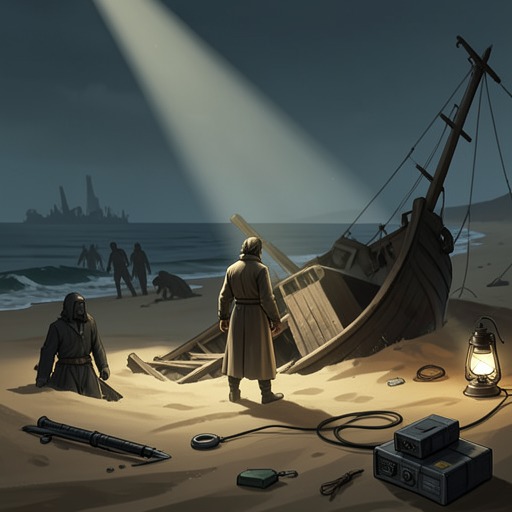
The disaster belonged to the Discovery’s attempt to reach farther east than any human vessel had gone. Its expedition ended in the Grave of Wood, a region of enormous carved biers protected by a gigantic serpentine guardian. The wreck’s position beside a grave that had been defaced, with an enormous sledge leaning against cracked wood and salt and something shining within, shows that the expedition was not simply lost to mechanical failure. Someone or something disturbed the dead, and that intrusion brought the guardian down upon the explorers.
The exact contents of the bier were never known. Jonathan Heights understood that trying to enter it had summoned the guardian, and he explicitly rejected repeating that mistake. The disaster therefore preserves a boundary between exploration and desecration: the Discovery could be approached, but the grave could not safely be opened, and the expedition’s attempt to cross that distinction appears to have destroyed it.
Destruction of the Expedition
When the Endeavor reaches the site years later, the Discovery hangs close to the ground, its lifting gas having escaped over the intervening period. It is smaller and squatter than the Endeavor, held in place by tether chains beside the damaged bier. The vessel itself remains accessible, but the surrounding graveyard is undisturbed, with no tracks or other signs of later human activity. The physical scene makes the catastrophe visible as suspended abandonment rather than as a conventional wreck: the ship survives, while the expedition that brought it there has disappeared.
Inside, the Discovery is almost exactly as Jonathan left it years earlier. Uniforms lie in puddles on the floor without any trace of the bodies that wore them, as though the men had evaporated. The implication is not a clean evacuation but a violent or uncanny removal, and Antomine treats each abandoned uniform as a place requiring words of remembrance. The ship’s small size allows the inspection to be completed quickly, after which airmen begin preparing it for salvage.
The disaster is also part of the larger chain of dangers surrounding the Endeavor’s eastern passage. The crew has already survived boarding by a mercenary force, the corruption and destruction of Danner’s Grasp, a lava flood in which the landscape itself awakens around molten rock, and the time-distorting hazards of the Crimson Caldera. At the Grave of Wood, the threat takes a different form: the ship is endangered not by an attack that can be fought, but by a guardian enforcing a prohibition that the earlier expedition failed to respect.
The Grave of Wood and the Guardian
The Endeavor reaches the graves while fleeing a violent cyclone. Montgomery lowers the ship into the lee of one of the enormous biers, allowing the carved wooden structure to shelter the vessel while airmen secure it with tethers, tarps, and metal shutters. Before the storm can strike, a vast sinuous silhouette rises among the graves. The guardian coils around the cyclone as though the storm were solid and swallows its lightning-filled body, silencing the wind and debris within minutes before disappearing among the biers.
This encounter retrospectively clarifies the Discovery’s fate. The guardian is not merely a monster occupying the expedition’s route; it is an active protector of the dead. Its response to the Endeavor is restrained because the crew remains outside the graves, whereas the Discovery’s derelict condition and the defaced bier indicate that its expedition crossed the forbidden threshold. The wreck is thus evidence of a rule enforced by a power older and stronger than human technology.
The wreck itself is safe enough to salvage because the guardian does not attack it. Lingering zint glow still shines from the Discovery’s bridge, and Jonathan explains that the guardian has left the ship untouched. The contrast is precise: only the vessel is safe, while anything belonging to the east would have extinguished the zint as a matter of nature. The technological remains therefore survive within a hostile environment not because humanity has mastered that environment, but because the guardian’s attention is limited by its own law.
Survivors, Memory, and Recovery
The only living remnant discovered aboard the Discovery is Dreyfus, its tortoiseshell ship cat. He flies through the open hatch after Penelope appears on the Endeavor, somehow still alive after the attack and years of solitude. Penelope briefly confronts him, then sneezes and walks away; Dreyfus follows and quickly finds refuge in Sarah’s arms. His survival creates a guarded optimism among the crew, but it does not soften the fate of the human expedition. The cat is a living continuation of the ship, while the missing crew remain represented by uniforms, empty spaces, and Antomine’s rites.
Jonathan’s return to the Discovery produces a more complicated recovery. The vessel stirs vague and uncomfortable memories in him, but sunlight burns those emotions away and replaces them with a sense of certainty. He sees the ship simultaneously as the relic of a profound discovery and as useful salvage: a waypoint rather than a destination. That double vision marks his altered relationship to the expedition. The Discovery once belonged to the path that made him, but after his later encounters with sunlight, death, lost friendships, exile, and the Players’ Game, it no longer possesses the authority it once held over him.
The inspection confirms that the ship remains a monument to absence. Antomine leads the examination because determining the final fate of the men is part of his religious and inquisitorial duty, while Jonathan leads because he knows the ship. Their cooperation joins practical salvage to ritual witness. Antomine’s observation that this was the furthest east any human vessel had reached, and yet only an abandoned derelict remained, makes the Discovery a compressed history of exploration’s ambition and cost. Jonathan answers that the greatest risk is always the unknown, a judgment Antomine regards with disapproval but that the wreck itself seems to substantiate.
Consequences and Significance
The disaster establishes the eastern frontier as a place where technological persistence cannot substitute for understanding. The Discovery traveled farther than any human vessel, but distance did not produce mastery; it produced a derelict beside a grave whose contents remained unknowable. The event therefore changes the meaning of exploration in the narrative. Progress is measured not only by how far a ship travels, but by whether its crew can recognize the laws of the world it enters.
Its consequences also remain personal. Jonathan carries the expedition as part of the accumulated cost that eventually leads him toward Bright Defile. In the final reckoning of what he must sacrifice or remember, the books he threw from the Endeavor, the death of Tiuni, the destruction of Tor Ilek, the laying of a god to rest, the sacrifice of Angkor Leng, his loss of Eleanor’s friendship, his banishment from Ukaresh, and his rejection of the Players and the Game all illuminate his path. The Discovery is not named there as an isolated triumph; its disaster belongs to the history of abandoned routes and irreversible choices that Jonathan must pass beyond.
For the surviving crew of the Endeavor, recovery offers only limited consolation. Dreyfus survives, the ship can be inspected, and salvage can begin, but the expedition’s human cost cannot be repaired. The Discovery remains a warning preserved in wood, salt, escaped gas, empty uniforms, and a cat that should not have lived. Its final significance lies in that contrast: a ship can endure as an object long after the purpose that sent it east has been annihilated, leaving later travelers to decide whether the wreck is a prize, a memorial, or a boundary marker against repeating the same error.